
Running OpenClaw Safely: Identity Controls, Isolation Gaps & Runtime Risk Analysis
Self-hosted AI agent runtimes like OpenClaw are proliferating in enterprise pilots, but they carry inherent security weaknesses.
OpenClaw can process untrusted text inputs, fetch and execute “skills” from public repositories like ClawHub, and operate under user-assigned credentials, fundamentally altering the traditional security boundary from static code to dynamic, third-party content.
This shift introduces immediate risks in non-isolated setups: credential exfiltration, persistent state manipulation via attacker instructions, and host compromise through malicious skills.
Enterprises must treat OpenClaw as untrusted code, deploying it only on dedicated virtual machines or air-gapped systems with minimal privileges and rigorous monitoring.
Runtime vs. Platform Risks
OpenClaw, the self-hosted runtime, executes on local workstations, VMs, or containers and inherits the host’s trust level. Installing skills equate to running arbitrary code, often sourced from ClawHub without robust vetting, expanding the attack surface to include dynamic code loading.
In contrast, platforms like Moltbook serve as identity and instruction hubs, enabling scalable propagation of malicious content across agents. Their interplay creates a dual supply chain: untrusted code from skills and untrusted prompts from external feeds, converging in credentialed execution loops.
Managed platforms mitigate this through centralized governance, but self-hosted runtimes like OpenClaw place full responsibility on organizations for host isolation, plugin controls, and state persistence. Without containment, a single tainted input can yield lasting compromise.
Attack Vectors Exposed
Indirect Prompt Injection: Malicious instructions embedded in ingested content can hijack tool usage or alter agent memory, persisting across sessions. Shared feeds amplify this, enabling a single payload to influence multiple high-privilege agents.
Skill Malware: Public registries host disguised malware as utilities, installed via low-friction mechanisms. Once loaded, skills access tokens, configs, and APIs, enabling data theft or reconfiguration without overt malware drops.
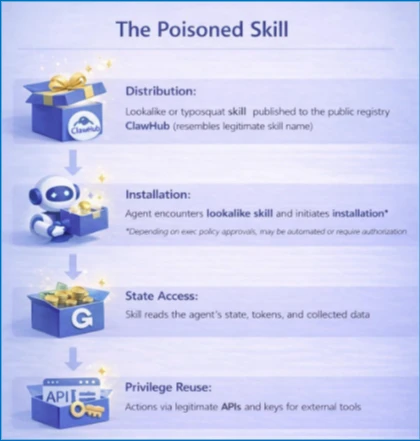
Poisoned Skill Chain: Attackers publish tainted skills to ClawHub (Step 1), trigger auto-installs (Step 2), extract state, such as OAuth tokens (Step 3), reuse privileges legitimately (Step 4), and embed persistence via scheduled tasks or consents (Step 5). This chain evades traditional defenses by mimicking benign automation.
Minimum Safe Posture
Avoid running OpenClaw on production workstations; instead, use disposable VMs with non-sensitive data and dedicated credentials that are rotated frequently.
Key guardrails include:
- Isolation: Dedicated hardware/VMs, no shared resources.
- Identity Scoping: Least-privilege Entra ID tokens, admin consent workflows.
- Monitoring: Audit state changes in
.openclaw/workspace/; snapshot for rebuilds. - Supply Chain: Pin approved skills, block unvetted installs via endpoint controls.
- Network Egress: Firewall to business-essential endpoints only.
Hunting Queries for Detection
Hunt 1: Runtime Inventory (DeviceProcessEvents)
DeviceProcessEvents
| where Timestamp > ago(30d)
| where ProcessCommandLine has_any ("openclaw","moltbot","clawdbot")
| project Timestamp, DeviceName, AccountName, FileName, ProcessCommandLine
| order by Timestamp desc
Triage unexpected deployments; validate pilots.
Hunt 1c: ClawHub Installs
DeviceProcessEvents
| where ProcessCommandLine has "clawhub install"
| extend SkillSlug = extract(@"\bclawhub\s+install\s+([^\s]+)", 1, ProcessCommandLine)
| summarize by SkillSlug
Flag low-prevalence slugs for review.
Hunt 5: Shell Spawning
DeviceProcessEvents
| where InitiatingProcessFileName has_any ("openclaw")
| where FileName in ("cmd.exe","powershell.exe","curl")
Prioritize credential-accessing spawns.
Additional hunts target OAuth drift, listening ports, and extension churn, enabling proactive scoping.
Self-hosted agents like OpenClaw demand an “assume breach” mindset: isolate runtimes, minimize blast radius, and prioritize recoverability over perfect prevention. Inventory deployments, audit identities, and deploy hunts immediately to shrink exposure.
For most, avoidance trumps evaluation. When piloting, integrate Microsoft Defender XDR for end-to-end visibility. Recent incidents underscore that misconfigurations expose UIs, and over-permissive tools turn promising tools into liabilities.
Site: cybersecuritypath.com
Reference: Source
About the Author


